A Retrospective on the Audemars Piguet CODE 11.59
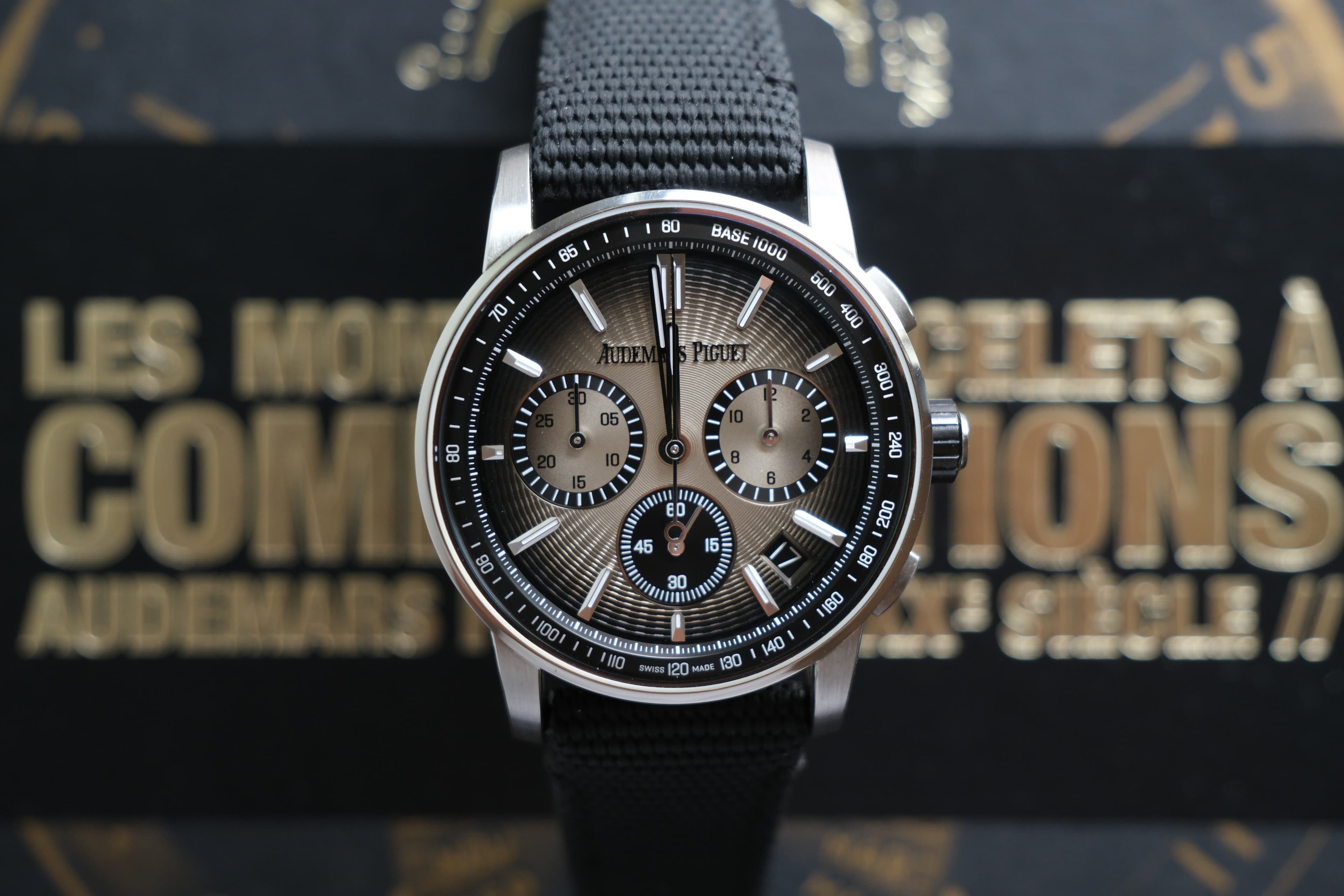
The general consensus of the watch community for the past five years has been to lambast the CODE 11.59 at every opportunity. And yet, this vitriol is insane, especially when you look at the current iterations of the watch.
A Troubling Release: The First Generation
The initial release was not without fault. The first dials were uninspired and bland, lacking the visual depth that collectors expect at this price point. The promotional photography made things worse by focusing almost exclusively on frontal shots, presenting the watch in a flat, two-dimensional plane when it's really a watch that excels in 3D.
This watch has so many facets, so many transitions between brushed and polished surfaces, that are absolutely stunning in person. The flying buttresses extending the lugs out are a touch of elegance, and then there's the crystal. The concave-convex sapphire creates this mesmerizing optical effect that you simply cannot appreciate from a straight-on product photo. AP chose to market the watch from its worst angle.
Then there's the name. CODE is an acronym: Challenge, Own, Dare, Evolve. It's no surprise that this bit of cringeworthy marketing has been mostly scrubbed from the AP catalog and only really lives on in the memory of those who were following the 2019 launch (and those who dare to ask what CODE stands for). The "11.59" part, though, is somewhat poetic. The last minute before a new day. A dawn bringer striding into the future of AP, and the swan song of François-Henry Bennahmias and his tenure at the company. What the name symbolizes is great, but first impressions matter, and AP didn't sell that vision at launch.
I'll admit it: on the initial release I was a skeptic too. The CODE confused people. It confused me. Looking back, the name is almost fitting in the sense that the watch is a code that needs to be broken in order to really understand it and see why it's one of the best offerings in the AP catalog to date.
A Historical Reference Hiding in Plain Sight
I feel like AP really missed an opportunity to highlight their ability to pull from their own archives. While the numerals and handset feel odd in a modern context, they actually pull directly from vintage AP dress watches of the mid-twentieth century.
Take a look at the reference 5042BA from 1952. It's a classically proportioned yellow gold dress watch whose applied Arabic numerals and leaf hands bear an unmistakable resemblance to what appears on the CODE 11.59 dial. The same design language shows up in the reference 5504 triple calendar moonphase from the same era. These are not coincidental similarities. They are deliberate homages to the brand's own history.
Everyone who picks up a CODE will tell you about how the mid-case pays tribute to the Royal Oak. Yet few will tell you how the dial and numerals are homages to a much earlier chapter of the manufacture's history. AP had a compelling story about heritage meeting modernity sitting right there, and they chose not to tell it.
New Dials: The Next Generation
The great thing is that dials are the easiest element to improve in a watch. If the initial release had poor ergonomics or flawed case design, the line would have been doomed. Case architecture is expensive and slow to revise. Dials can always be changed and improved upon.
And improve them AP did. The second generation introduced fumé dials, those gorgeous sunburst gradations that shift from deep saturation at the edges to lighter tones at the center. They brought the visual depth that the original lacquer dials lacked and gave the CODE 11.59 the kind of wrist presence that collectors had been waiting for.
Ceramic Midcases
What I like to call generation 2.5 introduced ceramic midcases to the chronograph variants. This pushed the CODE further in a sporty direction and showed off what AP can do with the line. The newly introduced brushed dials paired with the matte ceramic really brought the watch together. It finally felt like it knew what it wanted to be.
The Steel Codes
We finally got the CODE 11.59 in steel for the third generation. The initial release in precious metals was likely a practical necessity. The extreme complexity of this case, with its tight tolerances and numerous mixed-finish surfaces, makes steel production actually quite demanding compared to softer gold alloys.
With the steel release, AP leaned fully into modern design and created a CODE that lost basically all the controversy of the initial launch. There's nothing wrong with the steel codes. They're handsome, well-executed watches. I just wish that if AP was going to commit to this watch in steel, we'd see proper water resistance added and a full rubber strap option, making the steel CODE a serious contender to the Aquanaut and the PM CODE a contender to the Calatrava. A two-for-one from a single product line.
The 38mm Question
One of the biggest complaints about the CODE is its size. At 41mm with a 50mm lug-to-lug, it's formidable for a "dress watch." AP has recently released 38mm references which are interesting hybrids of the steel and PM codes. They use the dials from the steel code but the inner bezels from the precious metal references.
I initially wasn't too big a fan of this release. Then I saw someone replace the factory strap with the rubber-coated Kevlar strap and it makes a world of difference. On the sportier Kevlar strap we see a much more dynamic and interesting watch.
I only wish AP would commit to the smaller size and use an in-house ultra-thin movement, which they are 100% capable of building. There's nothing wrong with the caliber 5900, but it seems like AP is trying to have it both ways, hyping up their in-house 4302 and 4401 movements while using outsourced movements in their smaller pieces. It's no secret that creating a new caliber is a lot of work, but if the CODE is truly meant to be a pillar of the brand alongside the Royal Oak, it deserves that level of investment. Besides the movement, the 38mm form factor feels right for this watch, especially for those who can't comfortably wear the 50mm lug-to-lug of the 41mm code.
Where the CODE Really Shines: High Complications
This is where the CODE 11.59 truly comes alive. The perpetual calendar on the aventurine dial is one of the most beautiful executions of aventurine I've ever seen in any watch from any manufacturer. The CODE craves complications. Every new complication introduced to the line creates an entirely new look that might as well be its own product.
People often say the Royal Oak is the greatest blank canvas ever made. I think the CODE gives the Royal Oak a run for its money in this regard. The perpetual calendar, the Starwheel, and the Universelle Supersonnerie are all the same watch, yet they couldn't be more different from each other. Each complication makes it feel like an entirely different line.
The Ultracomplication is a pure flex from AP to show that they haven't let their watchmaking skills falter and can still compete with anyone at the highest levels of horology. At over a million dollars MSRP, it's really a piece you'll likely never see outside of a museum or salon event. But its existence elevates everything else in the lineup.
The Verdict, Five Years On
The CODE 11.59 story is one of redemption through iteration. A mismanaged launch obscured what was always a thoughtfully designed and historically grounded watch. AP has spent the years since proving the skeptics wrong, not through marketing, but through the work itself. Better dials, new materials, expanded sizing, and extraordinary complications have built a case that the initial reaction failed to anticipate.
For collectors with an eye toward the long view, the early precious metal codes, particularly the perpetual calendars, may represent some of the most interesting buying opportunities in the current AP catalog. The watches the market initially dismissed often prove to be the ones worth paying attention to.