Audiguet: The Audemars Piguet Sub-Brand That Helped Save the Company and History Forgot
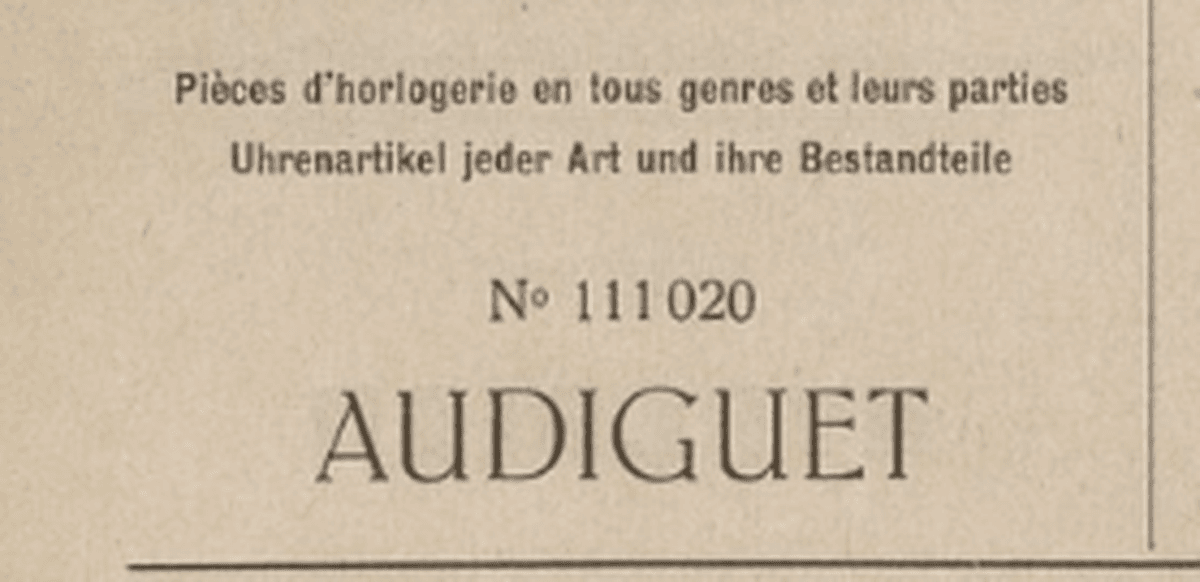
By the mid-1940s, Audemars Piguet was emerging from the deepest crisis in its history: fifteen years of consecutive losses from 1930 to 1945. The crisis was so severe that in 1932 the manufacture produced only two watches, and between 1931 and 1936 the company's total output fell to fewer than 350 watches, averaging under sixty per year.1 The financial damage was reflected in the corporate record: in 1936, the company reduced its share capital from CHF 250,000 to CHF 100,000, a 60% contraction formally documented in the Swiss commercial register.1b Then the war came. In April 1940, Audemars Piguet resigned from the Chambre de Commerce Suisse en France alongside fellow watchmakers Golay Fils et Stahl and Looping S.A., part of a broader withdrawal of Swiss firms from French commercial institutions as trade conditions deteriorated.1c AP's membership in the Swiss-French trade chamber confirms its commercial presence in France, and the loss of that channel added to the financial pressure that had been building for a decade. It was during this period that the idea of lower-cost sub-brands was first considered. Two names were proposed: "Audiguet" and "APCO." These brands would allow the manufacture to take movement blanks from a different supplier, likely finish and regulate them in-house, and send the watches to market under the sub-brand name, preserving the Audemars Piguet name for its finest work while generating much-needed revenue through a separate channel.
The strategy has an obvious parallel in the watch industry: Rolex and Tudor. But whereas Tudor became one of the most successful watch brands of the twentieth century, Audiguet had a brief and largely undocumented life before being almost entirely forgotten.
This article presents a dedicated study of the Audiguet brand, drawing on trademark records, auction catalogues, dealer listings, and private collections to document every known surviving example. It is independent research conducted without access to Audemars Piguet's internal production ledgers or archive. Where the evidence permits confident conclusions, they are stated directly; where it supports only informed inference, the reasoning and its limits are noted.
Disclosure. Two of the ten specimens catalogued in this article are held in the Remontorium collection and were examined directly by the author. One of those two was acquired from Durland & Co., a New York jeweller whose own website is cited below as an independent reference for the Cresarrow-Blank-Tiffany supply chain. The novel trade-supply / service-replacement thesis set out later in this article rests in part on direct examination of those two specimens and should be read as inference from a small sample, not as a confirmed conclusion. The author has no financial interest in appreciating Audiguet market values beyond personally holding these two watches.
The Origins of Audiguet
The earliest official documentation of Audiguet is the Swiss trademark registration, reproduced below. The mark was registered on 19 June 1945 at 4:30 p.m. by the Societe anonyme de la Manufacture d'horlogerie Audemars Piguet & Cie, Le Brassus.2 The registration covered pieces d'horlogerie en tous genres et leurs parties, that is, horological pieces of all kinds and their parts.
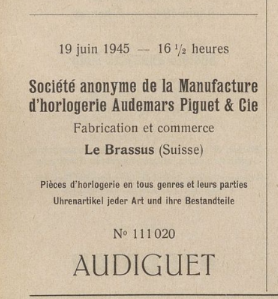
Original Swiss trademark registration for "Audiguet," 19 June 1945.
The broader context is laid out in the company's own authorised history. In May 1945, Georges Golay, a businessman who had caught the attention of Jacques Louis Audemars at a gymnastics session, joined the firm as an accountant and quickly rose to a leadership role.3 Two years later, the firm engaged Meyer, a La Chaux-de-Fonds management consultant, to assess its operating model. The resulting report recommended three changes: a second line of less expensive watches sold alongside the existing high-end range; price corrections to address what Meyer described as ex-factory values "systematically undercalculated in the preceding years"; and an organisational separation between the manufacturing and sales functions.4 The Meyer report of 1947 validated a strategy that had already been set in motion: the Audiguet trademark had been filed in June 1945, and active production began, per both Brunner and the 1995 Antiquorum catalogue, in 1947.
The Brunner book judges the sub-brand strategy favourably: "Audemars Piguet's decision in 1945 to build up a second leg by registering 'Audiguet' and 'APCO' as additional trademarks proved a wise one. From 1947, watches of this category were produced based on calibres of different manufacture, while the high-quality models still figured in the production range."5 The Antiquorum catalogue specifies that the ebauches were sourced from Ebauches SA but does not state where the finishing and regulation were carried out.6 (Brunner's own phrasing is more cautious, referring only to "calibres of different manufacture" without naming a specific supplier.) An ebauche is a movement blank that requires assembly, jewelling, escapement adjustment, and regulation before it can be cased. Audemars Piguet had approximately thirty artisans on staff in 1945 and a long tradition of repasseurs, the finisher-watchmakers who carry out exactly this work. In-house finishing and regulation at Le Brassus is therefore the most plausible scenario, even if no primary documentation has survived to confirm it. A companion brand, APCO, was created on a similar basis, though its history remains less well documented; whether APCO was ever independently trademarked as a word mark remains unresolved in the digitised Swiss trademark record.6b
The 1948 Basel Trade Show
The Brunner book states that "in 1949, the directors of Audemars Piguet decided for the first time in the company's history to participate in the Swiss Trade Fair at Basle."7 AP Chronicles places this first participation in 1948. However, the exhibitor list for the XIIIe Foire Suisse de l'Horlogerie shows Audemars Piguet listed among the Fabricants d'horlogerie as early as 1943, five or six years before the dates given by either authorised source.7b
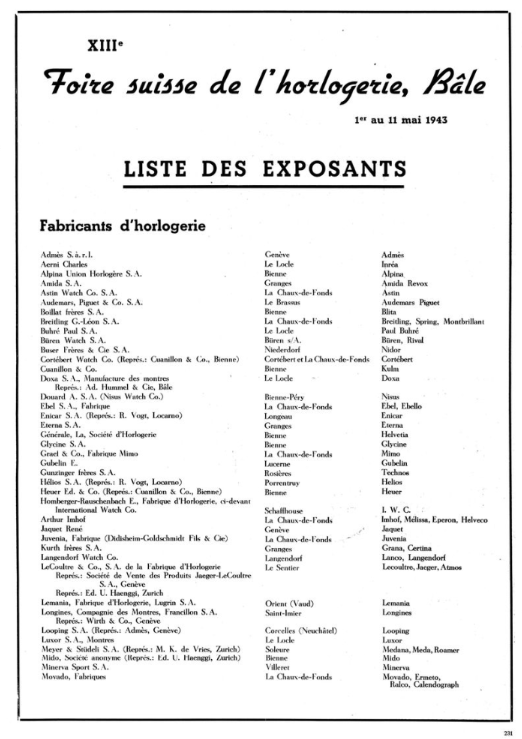
Exhibitor list, XIIIe Foire Suisse de l'Horlogerie, Basel, 1943. Audemars Piguet is listed among the Fabricants d'horlogerie.
The exhibitor list for the XVIIIe edition, held 10-20 April 1948, provides further evidence: Audemars Piguet is listed alongside Audiguet as a separate entry, the only such joint appearance documented in the exhibitor records examined for this study.7b The decision to give Audiguet its own exhibitor line at Basel is an unusual level of institutional commitment for a sub-brand and places the programme in front of the international trade at its commercial peak. AP Chronicles dates the abandonment of the sub-brand programme to 1948; on that timeline, the April 1948 Basel appearance was effectively the programme's final public outing, six to eight months before the SAPIC-driven reorganisation discussed below.
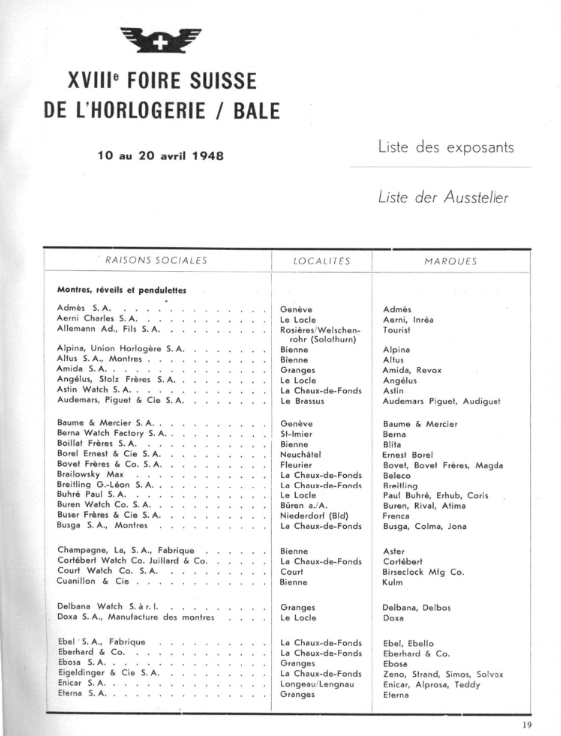
Exhibitor list, XVIIIe Foire Suisse de l'Horlogerie, Basel, April 1948. Audemars Piguet and Audiguet appear as separate entries.
The same year, according to the Brunner book, "the company closed its Geneva workshop. It also wound up relations with its United States agent; the brand name reverted to Audemars Piguet, who took over the agency via Audemars Piguet Inc. USA in New York."8 (The Musée Atelier's own history dates AP's Geneva operations from around 1885 to the mid-1970s, so Brunner's 1948 reference may describe the closure of a specific commercial or distribution office rather than of all Geneva activity.)8b That agent was Jean Louis Roehrich, who had operated from 599 Fifth Avenue since taking over from his predecessor Bayer in the early 1940s.9 The US market had been a persistent problem for AP. Before Bayer's tenure, the manufacture's American distributor had been Metric Watch of New York, whose 1930 bankruptcy left nearly CHF 425,000 in unpaid debts and came close to destroying the firm.9c
Roehrich was far more than a sales agent. Born in London in 1896, he immigrated to the United States in 1926 and established himself as a prominent figure in American horology. He served as head of the Horological Society of New York, one of the oldest horological institutions in the country, and was among the earliest members of the NAWCC, later serving as president of its Old Timers Chapter. He wrote "The National Watchmaker" column for National Jeweler magazine, and his expertise extended beyond the trade: according to NAWCC member records and specialist dealer accounts, he was credited with assembling Henry Ford's personal watch collection. (A primary-source confirmation from the Benson Ford Research Center has not been consulted for this essay.) His shop at 599 Fifth Avenue handled imports for several major Swiss houses, including Audemars Piguet, Zenith, Omega, Borel, and Zodiac, and he also produced his own private-label watches under his name using generic Swiss movements. That Audemars Piguet chose a figure of this calibre for its American distribution reflects the importance the company placed on the US market, even during its most difficult years.9b
Two of the ten known Audiguet watches are associated directly with Roehrich: the 1995 Antiquorum piece (whose catalogue entry states it was "made for J. L. Roehrich") and the Art Deco platinum specimen in the Remontorium collection (whose movement bears a "J. L. Roehrich" marking).
Through the late 1940s and into the 1950s, Audemars Piguet's financial position stabilised. The precise end date of the Audiguet programme is debated across sources and is examined in the Discussion section below; by the early 1950s at the latest, the name had disappeared from the market.
Known Surviving Examples
My research has identified ten Audiguet watches documented with varying levels of evidence. Two are in the author's possession and have been examined directly; five have appeared at professional auction houses with published catalogues and photographs; two are documented through active dealer channels (Instagram posts by Private Eyes Co. and @thewatcham); and one is recorded through a single forum post on orologi.forumfree.it whose archival persistence depends on the forum remaining online. They fall into two distinct groups that appear to reveal a dual-channel distribution pattern: gold-cased consumer watches sold through European and Asian retailers with "Audiguet" on the dial, and platinum-cased American watches where the Audiguet name is hidden on the movement behind a solid caseback.
The auction record
Three Audiguet watches have appeared at the premier European watch auction houses (Antiquorum and Christie's, Geneva). Two additional specimens have surfaced at regional American houses (Doyle New York and John Moran Auctioneers, Pasadena), discussed further below in the American-specimen and dealer/private sections respectively. The earliest, at Antiquorum Geneva in 1995, was a tonneau-shaped 18K gold lady's wristwatch with Cal. 45 movement, made for J. L. Roehrich, dated circa 1950 by Antiquorum (though the Roehrich marking suggests it predates 1948, as discussed below).10 Estimated at CHF 4,000-5,000, the lot went unsold. Its catalogue note provides the most frequently cited summary of the programme: "The submakes 'Audiguet' and 'Apco' were created in 1945 to provide to the Manufacture a second strength on the Market. From 1947, these watches were made with 'ebauches' by Ebauches SA."11
A second example appeared at Christie's Geneva in 2009 (lot 290, "Important Watches," Sale 1366), an 18K pink gold round wristwatch with Cal. 47 and two-tone silvered dial, circa 1947.12 Estimated at CHF 10,000-15,000, it sold for CHF 11,875. The lot essay explicitly compares the sub-brands to Tudor: "launched by Audemars Piguet in 1947 with the aim of providing less expensive watches in parallel with the top-of-the-range models. Their production was ceased by the end of the 1950s."13
The third, at Antiquorum Geneva in 2020, was an 18K pink gold dress wristwatch retailed by Maquet of Paris in a French case, circa 1947.14 Maison Maquet, founded in 1841, was a prestigious luxury goods house at 10 Rue de la Paix, near Place Vendome, with official purveyor status to Empress Eugenie. It was not a dedicated watch retailer but a high-end accessories firm, the kind of distribution channel that would have carried a luxury sub-brand without undermining the parent marque.14b All three of these premier European auction pieces are gold and all bear "Audiguet" on the dial. The Christie's and second Antiquorum pieces were retailed through European channels (Paris and Geneva). The 1995 Antiquorum piece, however, was made for Roehrich, AP's American agent, and represents the American consumer market despite later appearing at a European auction house. The two American auction-house pieces, examined in the American-specimens and dealer/private sections below, are platinum-cased and carry the Audiguet name only on the movement.
The American specimens
One of the three known American examples are in the Remontorium collection and another that we have access to is in a private collection. These are markedly different from their European counterparts. Understanding them requires recognising that these watches have lived two lives.
Both are Art Deco platinum cases dating to the 1920s or early 1930s, set with diamonds, originally housing movements by a different maker. Platinum cases from this era, particularly those retailed by Tiffany, regularly housed movements by C.H. Meylan of Le Brassus alongside other Swiss calibre makers. Meylan was among the notable calibre suppliers for American luxury jewelers throughout the 1920s and 1930s, producing baguette movements in sizes ranging from 5.8x16mm to 7x18mm for firms including Tiffany & Co.15b The supply chain ran through Henry Blank & Co. of Newark, New Jersey, trading as the Cresarrow Watch Co.: Meylan manufactured movements in Le Brassus, Cresarrow produced platinum cases in Newark, and Tiffany retailed the finished watches. Blank visited Tiffany weekly from about 1911.15c
Meylan ceased independent operations after Baume & Mercier acquired a stake in the firm in 1947, the year Audiguet production began in earnest. Full absorption followed in 1952. The coincidence of timing and geography invites an inference: Meylan and Audemars Piguet were both based in Le Brassus, and as one Vallee de Joux calibre maker exited the American supply chain, another may have entered it through the same trade networks. The surviving evidence does not confirm a direct succession, only that the conditions for one existed. Durland Co. of New York, one of the longest-established American jewellers, has documented the Cresarrow-Blank-Tiffany supply chain on its own website, attesting to how watches of this category moved between Le Brassus, Newark, and Fifth Avenue in the years that frame the Audiguet programme.15d
The most plausible reconstruction is that when the original movements in these cases required replacement, likely decades after manufacture, they were brought to an American jeweller for service. Rather than discard a valuable platinum and diamond case, the jeweller installed a new movement: an Audiguet Cal. 45, imported from Le Brassus, sized to fit the existing case with a movement ring. The Audiguet name appears nowhere on the exterior. On this interpretation, the case, the diamonds, and the dial all predate the Audiguet programme by years, and only the movement is Audiguet. Alternative reconstructions (contemporary 1940s Art Deco revival casing, or later collector-driven recasing) cannot be excluded from the physical evidence alone.
The private collection Audiguet is a platinum cushion-form case set with 28 diamonds, retailed by Tiffany & Co. The Cal. 45 movement inside bears the US import code "AYP" (Audemars Piguet's customs identifier under the 1936 US-Swiss trade agreement, discussed in the tariff-law section below) and the dual inscription "17 SEVENTEEN JEWELS," a format mandated by US tariff law of the Fordney-McCumber era.1527c27d
The second is an Art Deco rectangular platinum case with chased filigree work and 48 diamonds. The Cal. 45 movement is marked "J. L. Roehrich," AP's New York agent whose own tariff code was "ROR" under the same 1936 trade agreement. Roehrich held the AP agency from the early 1940s until AP took over US distribution directly through Audemars Piguet Inc. USA around 1948, placing this movement's import prior to that transition.1627d
These two specimens suggest an additional role for Audiguet Cal. 45 movements in the American market beyond finished consumer watches: premium service replacement calibres for an earlier generation of Swiss movements in high-value platinum cases. In this capacity they were supplied as bare movements to the jewellery trade through AP's American channel (Roehrich's Fifth Avenue agency prior to 1948, and Audemars Piguet Inc. USA thereafter) and installed behind solid casebacks, where the Audiguet name would remain effectively invisible to the collecting world.
A third American specimen, which surfaced at public auction, reinforces this pattern while introducing a previously undocumented node in the distribution network. Doyle New York (Lot 1155, from a Princeton estate) offered a platinum bracelet-watch set with ninety diamonds and a 0.65-carat pear centre-stone, its clasp signed "PETRI." The movement inside is an Audiguet Cal. 45. The clasp mark identifies the Edward E. Petri Company of Indianapolis, a platinum jeweller-fabricator founded in 1922 by a craftsman who came to New York from Paris and worked at Tiffany & Co. before opening on Monument Circle.16b Petri's documented Tiffany employment suggests the plausible supply mechanism: a former Tiffany craftsman would have retained access to the Fifth Avenue trade network that distributed Audiguet movements through Roehrich's agency, allowing him to acquire bare Cal. 45 movements for casing in his Indianapolis workshop. The precise transaction chain that brought this specific movement to Indianapolis cannot be reconstructed from the surviving evidence, but the Petri clasp mark adds a fourth documented American node to the Audiguet distribution picture alongside Roehrich, Tiffany, and AP's own post-1948 US office. It is the only node documented so far in a primarily fabrication role rather than import or retail.
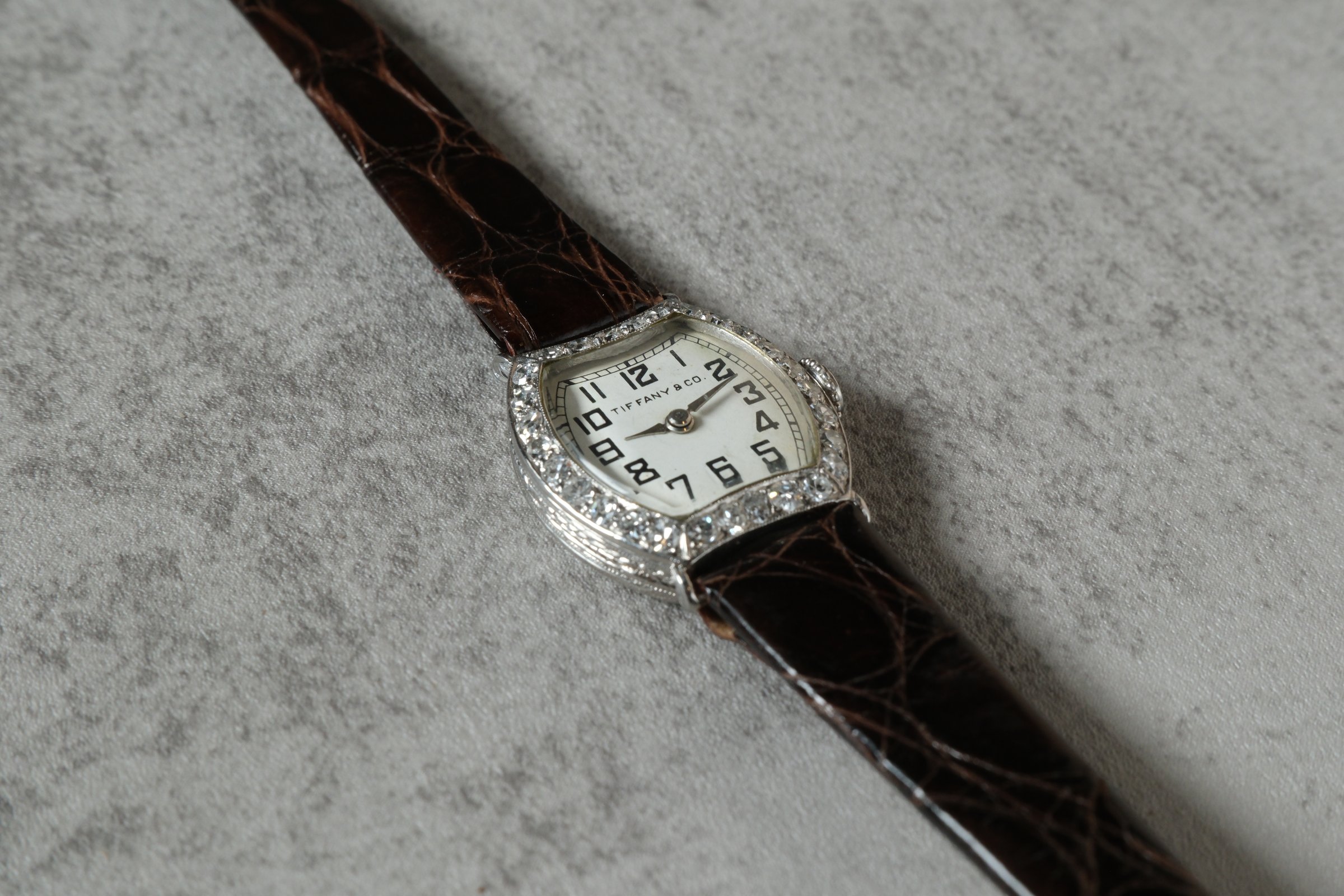
Audiguet Cal. 45, platinum and diamond, retailed by Tiffany & Co. Private Collection.
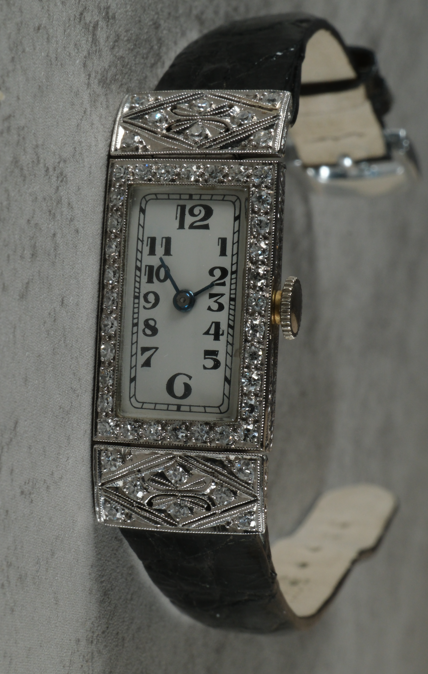
Audiguet Cal. 45, Art Deco platinum and diamond, marked "J. L. Roehrich." Remontorium collection.
Dealer and private examples
Four further specimens are documented through dealer listings, private collections, and auction records. A 14K yellow gold wristwatch with Cal. 47 and fancy lugs (Ref. 302, 34 mm) was offered by Private Eyes Co. of Tokyo with a rare vintage Audemars Piguet box.17 An 18K pink gold square wristwatch with a French-made case by Arakel Melick-Minassiant and reversible lugs is held by a Paris-based collector.18 A gold square-cased piece is documented through an Italian watch enthusiast forum.19 Finally, John Moran Auctioneers sold a platinum-cased wristwatch with sapphire-and-diamond bezel on a 14K woven-gold bracelet on 19 May 2025 (Lot 1057), cataloguing the movement as "Audiget 17 jewels." The misspelling allowed the watch to sell under the "Anonymous" designation for $1,778 against a $1,000-2,000 estimate, with no Audemars Piguet attribution made by the cataloguer.19b This finding suggests how easily such pieces slip past modern search indexes: a search across the major auction aggregators (Lot-Art, 1stDibs, Catawiki, LiveAuctioneers), watch-specialist platforms (WatchUSeek, NAWCC Forums), and general eBay listings for the misspellings "Audiget," "Audiguette," "Audiquet," and "Audignet" surfaced only this single piece, while the fashion brand Christian Audigier saturates commercial search indexes, rendering transcription-error Audiguets effectively invisible to collectors and researchers alike.
The Trademark Today
Audemars Piguet held the Audiguet trademark for seven decades after production ceased. The original 1945 registration (No. 111020) was renewed through a successor filing No. 336539, filed 21 December 1984 and registered 7 February 1985, with protection extending through 21 December 2014. Ownership was transferred to Audemars Piguet Holding SA on 14 August 2000. The mark was then allowed to lapse; a cancellation due to non-renewal was published on 27 July 2015.20
In 2024, the name was re-registered. A new application for "audiguet" (No. 812632) was filed on 3 April 2024 and registered five days later. The owner is not Audemars Piguet but a private individual based in Geneva with no apparent connection to the watch industry. The registration covers Nice classes 9 (smart watches, wearable activity trackers), 14 (watches, wristwatches, clocks, watch movements), and 37 (repair of clocks and watches), with protection extending to 3 April 2034.21
That Audemars Piguet allowed this historically significant trademark to lapse, and that it has now passed to an unrelated party, shows how completely the Audiguet chapter has faded from the company's institutional memory.
Discussion
The movements: finishing and sourcing
The surviving movements reveal the care that went into the Audiguet programme. The Cal. 45 specimens in the Remontorium collection exhibit anglage on the bridge edges, Cotes de Geneve on the bridge surfaces, perlage on the visible mainplate, and a bright reflective plating consistent with rhodium or nickel finishes used on contemporary Swiss movements; without metallurgical analysis the specific plating cannot be confirmed. Photographs of Cal. 47 specimens show consistent finishing. The jewel count was specified at seventeen rather than the fifteen of the base ebauche.22
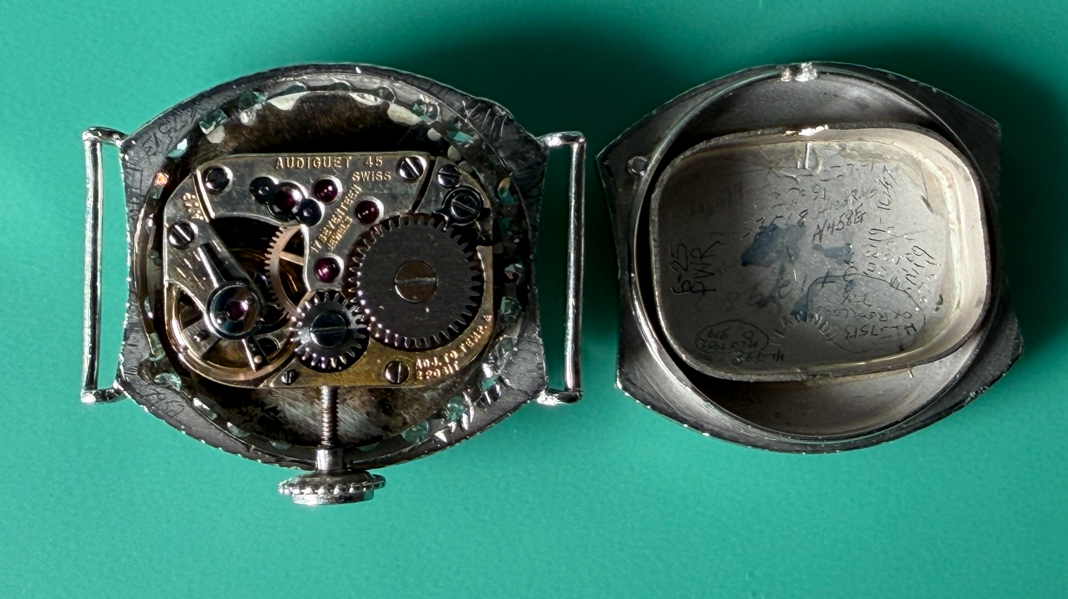
Audiguet Cal. 45 movement, Tiffany specimen. AYP import code and "17 SEVENTEEN JEWELS" marking visible. Private collection.
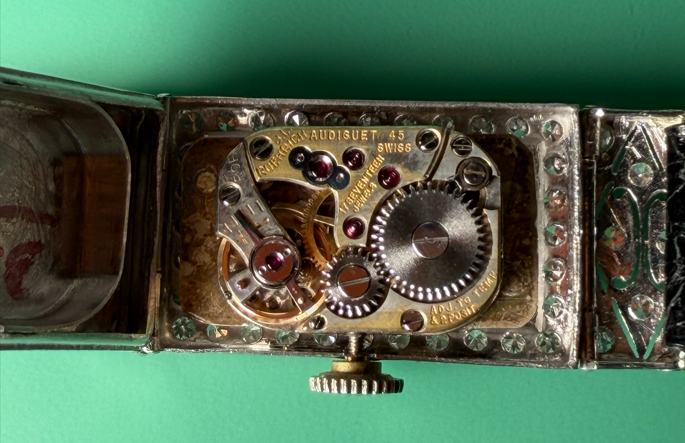
Audiguet Cal. 45 movement, Roehrich specimen. "J. L. Roehrich" marking visible. Remontorium collection.
The question of who performed this finishing is not entirely settled. AP Chronicles records approximately thirty artisans on staff in 1945, and the manufacture had a long tradition of employing repasseurs (finisher-watchmakers).23 In-house finishing would be consistent with standard practice among high-end Swiss etablisseurs of the era, a category distinct from both the vertically integrated manufactures and the bare ebauche makers.24 Girard-Perregaux, for example, used the same Peseux base ebauche (as their Cal. 05) with in-house finishing and a jewel count increased to seventeen.34 However, Ebauches SA members did offer factory-applied decoration as an option. FHF and A. Schild "often produced several variants of a basic movement with different shaped bridges and cocks, and sometimes with different finishes to the visible surfaces such as gilding, perlage or Cotes de Geneve."25 FHF is documented as having engraved "Tudor" on bridge plates at the factory.26 Without AP's internal production records, absolute certainty about the division of labour is not possible.
US tariff law and the seventeen-jewel standard
One marking on the American-market Cal. 45 specimens is not a matter of etablisseur practice but of law, and understanding it requires a brief detour into the US tariff structure that shaped Swiss watchmaking for half a century.
Beginning with the Dingley Tariff of 1897, the United States imposed import duties on watch movements based on their jewel count, creating a tiered system that directly influenced how Swiss manufacturers specified their calibres. The 1897 schedule set a flat tax of $0.35 per movement for seven jewels or fewer, rising through intermediate tiers to $1.25 for seventeen jewels and $3.00 above seventeen, with an additional 25% ad valorem on all tiers. The gap between the seventeen-jewel rate and the above-seventeen rate was designed to protect American railroad-grade production.27
The Fordney-McCumber Tariff of 1922 restructured the system. For movements with seventeen jewels or more, the ad valorem component was replaced by a tiered system based on the number of adjustments: $2.75 for an unadjusted movement, rising to $6.50 for a movement adjusted to five positions. Movements exceeding seventeen jewels were taxed at $10.75. The 1922 act also required that the jewel count and adjustments be stamped on the movement "in words," producing the characteristic double-numbering format seen on the Audiguet Cal. 45: "17 SEVENTEEN JEWELS."27b
The Smoot-Hawley Tariff of 1930 nearly tripled duty rates and required further differentiation of adjustment types (positions versus temperature). The rates on adjusted movements became so prohibitive that Swiss manufacturers began marking their American-export calibres "Unadjusted" regardless of actual regulation quality, simply to avoid the surcharge. The 1936 US-Swiss reciprocal trade agreement subsequently reduced rates and introduced the three-letter import codes (AYP for Audemars Piguet, ROR for Roehrich) that appear on the private specimens.27c
This tariff structure explains why seven and seventeen jewels became the two dominant specifications in Swiss export production. Seven sat at the bottom of the scale, minimising duty on economy movements. Seventeen sat at the top of the affordable tier, just below the punitive surcharge for additional jewels. The Audiguet Cal. 45's seventeen-jewel specification was not arbitrary: it placed the movement at the highest jewel count that could be imported without triggering the premium-tier duty, maximising perceived quality while keeping landed costs competitive. The "17 SEVENTEEN JEWELS" inscription is simultaneously a technical specification, a customs declaration, and evidence of a movement finished with the American tariff structure in mind from the outset.
A survival strategy that worked
The Brunner book, published in 1993 with AP's direct involvement, judges the sub-brand strategy favourably: the decision to register the trademarks "proved a wise one."28 It presents the Audiguet and APCO watches without embarrassment, illustrating several APCO and Audiguet pieces alongside the main narrative. And the evidence supports that assessment. Audiguet generated revenue for a manufacture that, only a decade earlier, had been producing fewer than sixty watches annually under its own name (with a nadir of two watches in 1932). It kept craftsmen employed and skills alive in Le Brassus at a time when the alternative was closure.
The auction houses, drawing on the Brunner book and their own research, consistently state that production continued until "the end of the 1950s," by which time AP's recovery was well underway.29 Audemars Piguet's own digital history platform, AP Chronicles, tells a different story. It states that in 1948 the "APCO and Audiguet sub-brands were abandoned" as part of a broader reorganisation.30 If taken literally, this would mean the sub-brands lasted only about one to two years of active production.
The 1948 reorganisation was driven by SAPIC (Societe anonyme des Participations Industrielles et Commerciales), a holding company founded in 1927 with stakes in Manufacture LeCoultre & Cie, Jaeger-LeCoultre, Vacheron Constantin, and other watchmaking firms. In 1948, SAPIC directors joined AP's board, and Jules Cesar Savary (1899-1966) became Chairman, a role he held until his death. Critically, LeCoultre & Cie became AP's main supplier of movement blanks.30b The Audiguet programme was built entirely on Ebauches SA calibres (Peseux for Cal. 47, likely Aurore-Villeret or A. Michel for Cal. 45). When LeCoultre became the manufacture's principal supplier, the Ebauches SA supply chain that had underwritten Audiguet would have become difficult to maintain at scale. This structural change probably contributed, alongside a conscious commitment to the brand's high-end identity, to the programme's abandonment. As a Worldtempus retrospective notes, the sub-brands were discontinued because they "did not correspond to the company's philosophy which, before any other consideration, prioritized high-end goods and quality."30c With LeCoultre now supplying movement blanks of a calibre consistent with AP's aspirations, the rationale for a lower-tier brand had simply disappeared. By 1958, nearly 75% of AP's production used a single LeCoultre-based calibre (AP Cal. 2003, derived from LeCoultre ebauche 803).30e The Ebauches SA supply chain that had made Audiguet possible was replaced entirely.
Timeline summary: conflicting accounts
1945 — Trademark registered (19 June). ~30 artisans on staff.
1947 — Production begins (Brunner; Antiquorum catalogue).
1948 — SAPIC restructure; LeCoultre replaces Ebauches SA as primary supplier. AP Chronicles states sub-brands "abandoned." AP participates in Basel "for the first time" per AP Chronicles (though exhibitor records show earlier attendance). Audiguet listed alongside AP as a separate entry.
Around 1948 — AP takes over US distribution directly via Audemars Piguet Inc. USA. The Tiffany specimen's AYP import code ties its import to AP's own channel rather than Roehrich's.
"End of the 1950s" — Brunner book and auction-house dating (Christie's 2009, Antiquorum 2020).
Assessment: Active production likely limited to 1947-1948; movements in the trade pipeline continued to surface into the early 1950s. The surviving examples are rarer than any previous account has recognised.
Yet the physical evidence from the two American specimens in the Remontorium collection directly challenges the 1948 end date. The Art Deco piece is marked "J. L. Roehrich" (whose own US import code was "ROR"), AP's US agent whose agency AP took over directly through Audemars Piguet Inc. USA around 1948. This movement was therefore imported through the Roehrich channel, before the direct-import transition. The Tiffany piece, by contrast, bears the import code "AYP," Audemars Piguet's own US customs identifier under the 1936 trade agreement, used by AP's direct operation rather than by Roehrich.27d This movement was therefore imported through AP's own channel. Where ROR ties a movement to Roehrich's pre-1948 New York agency, AYP ties it to AP's direct import operation, consistent with the post-1948 transition to Audemars Piguet Inc. USA. Whether any particular AYP-coded movement represents new production or existing stock cannot be determined from the stamp alone.
The truth likely falls between the two narratives. The formal Audiguet programme, the one with its own Basel exhibition stand and Ebauches SA supply contracts, ended in 1948 with the SAPIC reorganisation. But Audiguet movements already manufactured or in the trade pipeline continued to be imported and installed through the early 1950s, possibly later. (The Roehrich marking strongly suggests the movement was imported before 1948, when AP replaced Roehrich with its own direct distribution. Antiquorum's "circa 1950" dating may reflect the retail transaction rather than the movement's import date.) What is clear is that the active manufacturing window was far shorter than the Brunner book's "end of the 1950s" suggests, making the surviving examples rarer than any previous account has recognised. However one dates its end, Audiguet served its purpose: AP survived. Georges Golay, the accountant who arrived in May 1945, weeks before the trademark was registered, stayed for life. He rose to become Managing Director in 1966 and oversaw the launch of the Royal Oak in 1972. He held the position until his death in 1987.30d
A note on the Basel dates
The Brunner book states that AP's directors decided to participate in the Swiss Trade Fair "for the first time" in 1949. AP Chronicles places this debut in 1948. However, exhibitor records for the Foire Suisse de l'Horlogerie document AP's presence as early as 1943, five or six years before either date. The 1948 exhibitor list is clearly dated and shows Audiguet alongside AP as a separate entry. The discrepancy matters: 1948 is the year Audiguet appeared at Basel alongside its parent, and both the Brunner book and AP Chronicles inadvertently obscure that joint exhibition by misdating or omitting the earlier appearances.
Two markets, two business models
The surviving specimens reveal that Audiguet functioned as a consumer brand across multiple markets. In Europe and Asia, gold watches with "Audiguet" on the dial were sold through retailers like Maquet in Paris and Private Eyes in Tokyo. In America, the same consumer model operated: the 1995 Antiquorum piece, a gold lady's watch made for Roehrich with "Audiguet" on the dial, is indistinguishable in format from its European counterparts. But the two platinum specimens in the Remontorium collection reveal an additional American function with no parallel in the European record: bare Cal. 45 movements imported through AP's New York channel and installed by jewellers in vintage platinum cases as service replacements. On a sample of three American-connected specimens, it would be premature to declare this the dominant American role for Audiguet, but it is a distinctive one.
The European channel, particularly in France, involved a distinct supply chain shaped by French tax law. France imposed heavy duties on imported gold items, so Swiss brands routinely shipped bare movements across the border and had them cased locally by French goldsmiths.26b This explains why the French Audiguet specimens carry French gold hallmarks (the eagle head for 18k gold) rather than Swiss case marks. The cases were manufactured in France by contracted boitiers (case makers), while the movements arrived from Le Brassus. The @thewatcham specimen is particularly revealing: the case bears both the brand stamp "Audiguet" and a poincon de maitre (maker's mark) reading "Arakel Melick-Minassiant," a name consistent with the Armenian goldsmith diaspora documented in Paris through the interwar and postwar periods.26c Under French law, every gold case required the maker's own lozenge-shaped hallmark alongside the assay office's fineness guarantee. The Audiguet brand stamp on the case itself, not only the dial, establishes that Melick-Minassiant produced this particular case to Audiguet specification with the brand name applied during manufacture. Whether this reflects a standing supply arrangement or an isolated commission cannot be determined from a single documented specimen.
This was not unusual for Audemars Piguet. Even for mainline production, AP relied on independent Geneva casemakers: Wenger (Geneva Key #1) supplied cases for the manufacture's chronographs through the 1940s.26d The Audiguet programme simply extended this model into the French market, using local case makers to avoid import duties while maintaining control of the movement supply from Le Brassus.
The trade-supply function visible in the two platinum specimens appears to have no documented parallel in the commonly cited Rolex-Tudor analogy. Tudor was always a consumer-facing brand. Audiguet, when it reached an American wrist behind a Tiffany caseback, was invisible. Whether this reflects deliberate dual-channel planning by AP or the opportunistic liquidation of movement stock through an agent already handling finished watches cannot be determined from the surviving evidence alone.
Identifying the ebauches
Editorial note: The following attributions are based on dimensional matching, diagnostic mechanical features (principally the dual-screw crown wheel for Cal. 47), and contemporary movement databases. They have not been confirmed by Audemars Piguet production records or by direct inspection of the ebauche maker's stamps beneath the balance wheels of surviving specimens. They should be read as informed inference from the available evidence, not definitive identification. Readers with access to an Audiguet movement are encouraged to examine the maker's mark beneath the balance wheel and contact the author.
Calibre 47. The round men's movement measures approximately 10 1/2 lignes (~23.7 mm) and features a three-quarter plate construction with subsidiary seconds. Its most distinctive mechanical feature is a dual-screw crown wheel core, a retention technique protected by Swiss Patent No. 97101 (Aegler, 1922), which had entered the public domain by the 1940s and was therefore available to any ebauche maker.31 Among Ebauches SA members producing 10 1/2-ligne manual-wind calibres in this era, the dual-screw crown wheel is a documented characteristic of the Peseux 180 family, confirmed on the Peseux 320 and Peseux 7000 (later calibres in the same dimensional family).32 The base Peseux 180 specification (10 1/2 lignes, 18,000 vph, subsidiary seconds per the standard sub-seconds variant, no shock protection) aligns with every documented parameter of the Audiguet Cal. 47, and the dual-screw crown wheel is the diagnostic feature distinguishing the Peseux 180 family from other Ebauches SA calibres at this size.33 Girard-Perregaux used the same platform as their Cal. 05, with the jewel count increased to seventeen, the same specification observed on the Audiguet.34 Peseux joined Ebauches SA in 1928 and was fully absorbed by 1932.35
The Peseux 180 platform was produced in variants documented from 180 through 184 (with sub-variants such as 180A, 181A, 182A), all sharing the same gear train coordinates and winding mechanism but differing in bridge contour.36 Comparison of two photographed Cal. 47 specimens reveals that Audemars Piguet used at least two of these variants: one with a captive barrel (the ratchet wheel enclosed beneath the bridge) and one with an exposed ratchet wheel above the bridge plane. Both share the diagnostic dual-screw crown wheel. The existence of two distinct bridge configurations under the same "Cal. 47" designation confirms that the number is a commercial label, not a technical specification tied to a single ebauche.
Calibre 45. The rectangular ladies' movement measures approximately 5 1/4 to 5 3/4 x 8 1/2 lignes (roughly 12 to 13 x 19 mm), a measurement range that has not been resolved to the fractional ligne without direct caliper inspection of a surviving example. Within the Ebauches SA consortium, the number of manufacturers producing rectangular lever-escapement movements at these dimensions was extremely limited. Two candidates emerge from contemporary movement databases. Aurore-Villeret (Fabrique d'Ebauches Bernoises SA, Etablissement Aurore, Villeret), a subsidiary of Ebauches SA from 1927, produced its AV 102 calibre at 5 3/4 x 8 1/2 lignes with the architecturally distinctive feature of "round or straight corners" documented as a factory variant, accommodating exactly the squared-edge bridges visible on Audiguet Cal. 45 specimens.37 A. Michel (Grenchen), a founding member of Ebauches SA, produced its AM 115 at the smaller dimension of 5 1/4 x 8 1/2 lignes.38 If the Cal. 45 measures 5 3/4 lignes, AV 102 is the candidate; if 5 1/4, AM 115 is the match. Other contemporary Aurore-Villeret rectangular calibres (AV 11, AV 13, AV 17) are documented at incompatible sizes per balance-staff cross-reference tables, and are excluded by dimensional grounds.39 Definitive attribution requires physical caliper measurement and inspection of the maker's mark beneath the balance wheel on a surviving specimen.
What remains unknown
Significant gaps persist. The specific ebauche variant within the Peseux 180 family used for the Cal. 47, and the choice between Aurore-Villeret and A. Michel for the Cal. 45, cannot be resolved without physical inspection of the maker's stamps beneath the balance wheels of surviving specimens. Total production figures are unknown. The companion brand APCO is even more obscure. The Brunner book illustrates cased APCO watches with printed dials, proving they were manufactured as finished consumer products. Yet no APCO watch has been located in a public auction, dealer listing, or documented private collection during the research for this study. If, as the trademark record suggests, APCO was never independently registered as a word mark, its effective absence from the public record becomes explicable: a sub-brand that existed as a corporate hallmark or label rather than as a trademarked consumer brand would have left a thinner documentary trail from the outset. And at least three additional Audiguet watches have surfaced in fragmentary online references (forum posts since deleted, listings on defunct websites) but cannot be independently verified from surviving evidence.
Conclusion
The Audiguet programme kept a struggling manufacture alive. After nearly fifteen years of consecutive losses and production that had fallen to as few as two watches in a single year, Audemars Piguet found a way to generate revenue, maintain its workforce, and preserve the skills of its finishers without compromising the prestige of the primary brand. The movements themselves, with their careful anglage and Cotes de Geneve, reflect the same commitment to craft that defined AP's mainline production. These were not disposable movements with a borrowed name; they were finished to a standard that any Vallee de Joux watchmaker would recognise as serious work.
The ten surviving examples document a brand that operated across two continents and at least two distinct market channels. They are scattered across auction archives, private collections, and, in the case of the two American specimens, the Remontorium collection. Together, they tell the story of a small company in the Vallee de Joux that did what it had to do, did it well, and lived to build the Royal Oak.
The Audiguet trademark, held by AP for roughly seven decades after the programme ended, was ultimately allowed to lapse and re-registered in 2024 by a private individual in Geneva. Whether this represents a speculative acquisition or the beginning of a revival remains to be seen. What is certain is that the handful of surviving watches are the only physical evidence accessible to independent researchers of a programme that played a genuine part in sustaining the manufacture through its most difficult period.
Acknowledgements
The historical exhibitor lists and the 1945 Audiguet trademark registration reproduced in this article were sourced from the Watch Library, a digital archive of primary horological documents.
Notes
[1] Production figures cited in Gisbert L. Brunner, Christian Pfeiffer-Belli and Martin K. Wehrli, Audemars Piguet: Masterpieces of Classical Watchmaking, 1st edn (Munich: Audemars Piguet, 1993), pp. 36-38. See also Goldammer, "Audemars Piguet's Historic Production", which reports 1931-1936 aggregate output of under 350 watches. ↑
[1b] Feuille Officielle Suisse du Commerce (FOSC), 27 June 1936. Capital reduced from CHF 250,000 to CHF 100,000 by reducing each share from 500 fr. to 200 fr. Geneva branch noted. Paul-Louis Audemars and Paul-Edward Piguet listed as directors. Available at E-periodica. ↑
[1c] Revue economique franco-suisse, vol. 20, no. 5 (1940), p. 224. Communications of the Chambre de Commerce Suisse en France, meeting of 23 April 1940. Audemars, Piguet et C° S.A. listed among "Demissions" alongside Golay Fils et Stahl (Geneva) and Looping S.A. (La Chaux-de-Fonds). Available at E-periodica. ↑
[2] Swiss Federal Institute of Intellectual Property, trademark No. 111020, filed 19 June 1945. Confirmed by Feuille Officielle Suisse du Commerce, N. 158, 10 July 1945, available at E-periodica. ↑
[3] Brunner, Pfeiffer-Belli and Wehrli, pp. 35-36. ↑
[4] Ibid., p. 36. ↑
[5] Ibid. ↑
[6] Antiquorum, The Art of Audemars Piguet, Geneva, 21 October 1995, lot 648, catalogue note. ↑
[6b] Brunner states that both trademarks were registered in 1945, but the only APCO-related filing located in the Swiss Federal IP database (No. 155123, November 1954) is a shield-form logo reading "A P & Co," identical to marks stamped inside mainline Audemars Piguet casebacks (e.g., Case No. 9945 signed "Audemars, Piguet & Co., Brassus & Geneve"). That is Audemars Piguet's corporate hallmark, not a distinct APCO sub-brand word mark. No separate word mark for "APCO" has been identified in the digitised SwissReg record. If APCO was never independently trademarked as a word mark, it may explain why no APCO-branded watch has ever surfaced in the public auction record. ↑
[7] Brunner, Pfeiffer-Belli and Wehrli, p. 36. ↑
[7b] Exhibitor list, XIIIe Foire Suisse de l'Horlogerie (Basel, 1943); exhibitor list, XVIIIe Foire Suisse de l'Horlogerie (Basel, 10-20 April 1948). Both documents reproduced from the Watch Library archive of primary horological documents. AP Chronicles places AP's first Basel participation in 1948: see AP Chronicles, "L'epopée AP," op. cit. ↑
[8] Ibid. ↑
[8b] Audemars Piguet, "A Unique Watch from 1943": "From around 1885 to the mid-1970s, Audemars Piguet had a workshop in Geneva to be closer to end clients and facilitate distribution within Europe and beyond." ↑
[9] Ibid., p. 35: "the activities of the Audemars Piguet agent in the United States, M. Bayer, failed to provide satisfaction and he was replaced by a certain Roehrich, who had a store on New York's Fifth Avenue." ↑
[9b] Biographical details from NAWCC Forums; National Watch & Clock Museum archives; dealer listings at empress.cc and symmetryjewelers.com. Roehrich was born 11 October 1896 in London, immigrated 1926, and died February 1981 in Connecticut. ↑
[9c] AP Chronicles, op. cit. Metric Watch of New York's bankruptcy and the CHF 425,000 debt are detailed in the pre-war section of the timeline. ↑
[10] Antiquorum, The Art of Audemars Piguet, Geneva, 21 October 1995, lot 648. Cal. 45, Case No. 1059, 17 jewels, 17 x 29 mm. Estimate: CHF 4,000-5,000. ↑
[11] Ibid. ↑
[12] Christie's, Geneva, 2009. Case No. 26,962, 31 mm, 17 jewels. ↑
[13] Ibid. ↑
[14] Antiquorum, Geneva, 9 December 2020, lot 10. Case No. 27466, 31 mm. Estimate: CHF 7,000-10,000. ↑
[14b] Maison Maquet, founded 1841 at Rue de la Paix, Paris, by the brothers Hector and Charles Maquet. Royal purveyor to Empress Eugénie during the Second Empire. Operated continuously until 1994; the brand was subsequently revived in 2014 under Luvanis. ↑
[15b] Meylan movement dimensions and production scope from Greg Steer, "Henry Blank and Cresarrow"; NAWCC Forums, "C.H. Meylan Production"; The Antique Guild. ↑
[15c] Henry Blank & Co. / Cresarrow supply chain documented at Durland Co., "Cresarrow / Henry Blank & Co." and Greg Steer. ↑
[15d] The Roehrich-marked Audiguet was acquired from Durland Co., which separately documents the Cresarrow-Blank-Tiffany-Meylan supply chain. Meylan cessation timeline from Time2Tell, "The True Story of C.H. Meylan" and Worldtempus, "Vintage Treasures of Baume & Mercier". ↑
[15] Now in the Remontorium collection. Previously sold via eBay, March 2026. ↑
[16] Now in the Remontorium collection. Previously sold by Durland Co., March 2026. ↑
[16b] Doyle New York, Lot 1155 (Princeton estate), 14.3 dwt, sold $3,150. Petri corporate history and Tiffany pedigree: "Charlie Walker: Craftsman Jeweler," Towne Post, available at townepost.com: "Edward Petri moved from Paris to New York City and worked at Tiffany & Co. for several years before moving to Indianapolis. He opened his own business on Monument Circle in 1922 just before Christmas." Edward Petri passed away in 1976; the business passed through Bill Thomas (1966-1996) to current proprietor Charles F. Walker, who acquired it in 1996. ↑
[17] Private Eyes Co. (@privateeyes_co), Instagram post, 14 March 2023. ↑
[18] @thewatcham, Instagram post, 17 March 2024, Paris, France. ↑
[19] User "Berry06," orologi.forumfree.it (accessed March 2026). ↑
[19b] John Moran Auctioneers, sale of 19 May 2025, Lot 1057. Estimate $1,000-2,000; sold $1,778. Cataloguer's movement description: "Audiget 17 jewels," with no Audemars Piguet attribution in the lot heading. ↑
[20] All dates in the renewal chain are drawn from the Swissreg records for the Audiguet mark: original registration No. 111020 (19 June 1945), successor filing No. 336539 (filed 21 December 1984, registered 7 February 1985), ownership transferred to Audemars Piguet Holding SA on 14 August 2000, protection through 21 December 2014, cancellation due to non-renewal published 27 July 2015. The Swissreg database requires interactive search rather than deep-linking; a full record-by-record walk of the Audiguet chain was conducted through the registry interface. ↑
[21] Swissreg, trademark No. 812632 ("audiguet"), filed 3 April 2024, registered 8 April 2024, protection through 3 April 2034, owner Alexandre Ayad, Geneva. The owner's professional background is documented in public business directories (e.g., B Lab Switzerland) as digital-transformation and non-profit consulting, not horology; this is the basis for the essay's "no apparent connection to the watch industry" characterisation. ↑
[22] The standard 15-to-17 jewel upgrade involved reaming the centre wheel pivot holes and friction-fitting synthetic ruby jewels. See, e.g., the Girard-Perregaux Cal. 05, which applied the same upgrade to the same Peseux base ebauche. urdelar.se (accessed March 2026). ↑
[23] AP Chronicles, op. cit. ↑
[24] The distinction between manufactures (vertically integrated), etablisseurs (assemblers and finishers who source components, particularly ebauches), and ebauche suppliers is set out in David Boettcher's survey of Swiss watchmaking structure at VintageWatchStraps, "Watch Encyclopaedia: Movements". Audemars Piguet's 1945-era operation, with its ebauche-sourcing for the Audiguet programme and in-house finishing tradition, falls within the etablisseur model even though its mainline work was closer to a full manufacture. ↑
[25] VintageWatchStraps.com, "Watch Encyclopaedia: Movements," vintagewatchstraps.com (accessed March 2026). ↑
[26] Ibid. ↑
[26b] The practice of shipping bare Swiss movements to France for local casing is documented across the industry. Omega, for example, shipped movements to the Besancon area for casing by French goldsmiths to reduce import charges. See discussions at Omega Forums and VintageWatchStraps, "Case Marks". ↑
[26c] French poincon de maitre system: a lozenge-shaped cartouche containing the maker's initials and a differentiating symbol, required on all precious metal items. See Lang Antiques, "Poincon". The Armenian goldsmith diaspora in Paris during the interwar and postwar periods is documented in several sources on Armenian jewellery heritage (the GemGeneve article previously at gemgeneve.com/jewellery-culture-and-armenian-heritage/ is no longer available online). ↑
[26d] Audemars Piguet, "A Unique Watch from 1943": "Produced by the prestigious Geneva casemaker Wenger, the 36mm case's harmonious curved shape is highlighted by so-called 'goutte' (drop-shaped) lugs." See also Goldammer, "Geneva Case Maker Key" (Wenger held Geneva Key #1 from 1934 to 1992, producing cases for multiple Vallée de Joux manufactures). ↑
[27] Dingley Tariff of 1897, Schedule N (sundries), as documented in NAWCC Forums, "Dating Watches by Tariff-Law Markings". The $0.35-to-$1.25 jewel-count tiers and the $3.00 + 25% ad valorem surcharge above seventeen jewels are detailed in this thread. ↑
[27b] Fordney-McCumber Tariff of 1922, Paragraph 367. The "in words" marking requirement is codified at 19 CFR 11.9 and referenced in 19 CFR 134.43(b). Additional U.S. Note 4, Chapter 91 HTSUS. Adjustment-based tiers ($2.75 unadjusted to $6.50 for five positions) from the same NAWCC source. ↑
[27c] Smoot-Hawley Tariff Act of 1930. The rate increase and its effect on "Unadjusted" markings documented in the NAWCC and WatchUSeek, "Notes on Movement Markings". The 1936 US-Swiss trade agreement and import code system from Timeplex, "US Import Codes". ↑
[27d] The AYP and ROR codes are documented in the same Timeplex lookup table, which lists "AYP" as Audemars Piguet and "ROR" as "Jean Louis Roehrick [sic], Audemars Piguet" — the latter reflecting Roehrich's status as AP's US importer of record at the time the codes were issued. Further discussion of the code system appears in the NAWCC forum threads "Marking Time: US Watch Movement Import Codes of 1936", "Three letter Swiss to USA import codes", and "Codes for Swiss Movements". Brunner (pp. 35-36) records AP's takeover of US distribution from Roehrich through Audemars Piguet Inc. USA in conjunction with the 1948 Geneva workshop closure but does not give an exact handover date; this essay treats the transition as "around 1948" rather than precisely dated. ↑ ↑ ↑
[28] Brunner, Pfeiffer-Belli and Wehrli, p. 36. ↑
[29] Antiquorum, Geneva, 9 December 2020, lot 10, catalogue note; Christie's, Geneva, 2009, lot essay. ↑
[30] AP Chronicles, "L'epopee AP," apchronicles.audemarspiguet.com (accessed March 2026). ↑
[30b] AP Chronicles, op. cit.: "Audemars Piguet's Board of Directors welcomed a number of key figures from the SAPIC group (Societe anonyme des Participations Industrielles et Commerciales) founded in 1927 and which has holdings in Manufacture LeCoultre & Cie, the Jaeger-LeCoultre sales firm, Vacheron Constantin, Etablissement Jaeger and other watchmaking companies." SAPIC confirmed via Europa Star. ↑
[30c] Worldtempus, "La reprise" (French), in the 150th anniversary retrospective series (accessed April 2026). LeCoultre calibre data from AP Chronicles, "Calibres 2120-2121" and Goldammer, "History of AP Slim Automatic". ↑
[30d] Golay's career: Watch-Wiki, "Georges Golay"; Archives culturelles de la Vallee de Joux; AP Chronicles portrait (1980). ↑
[30e] The 1958 production share is drawn from AP Chronicles, "Calibres 2120-2121", which places the AP Cal. 2003 (based on LeCoultre ebauche 803) at the centre of the manufacture's output in the second half of the 1950s, and Goldammer, "History of AP Slim Automatic". ↑
[31] Swiss Patent No. 97101, filed 2 August 1921, granted 1 December 1922. ↑
[32] 17jewels.info, "Peseux 7000" (accessed March 2026); WahaWatches, "Restoration: Peseux 320" (accessed March 2026). ↑
[33] EmmyWatch, "Peseux 180," emmywatch.com (accessed March 2026). ↑
[34] BestFit parts manifest 445/531 cross-references Peseux 184, GP Cal. 05, and GP Cal. 06. urdelar.se, EmmyWatch (accessed March 2026). ↑
[35] Grail Watch Wiki, "Fabrique d'Ebauches de Peseux," wiki.grail-watch.com (accessed March 2026). ↑
[36] EmmyWatch, op. cit.; windingstems.com, Peseux winding stem WS1674. ↑
[37] Ranfft.org; 17jewels.info, "Villeret 10"; eBay UK item 142471979237 (Ronda 312 balance staff for AV 10 and AV 102). ↑
[38] EmmyWatch, "A. Michel 115," emmywatch.com (accessed March 2026). The 5¼ × 8½ ligne dimensions are confirmed; the specific jewel-count configuration of the AM 115 requires contemporary catalogue cross-reference for definitive attribution. ↑
[39] Balance-staff dimensional constraints drawn from the Ronda cross-reference tables as catalogued at balancestaffs.com (accessed March 2026; the specialized database may require authentication). AV 11 and AV 13 are documented at 6½ ligne, AV 17 at 4⅔ ligne — all dimensionally incompatible with the Audiguet Cal. 45 rectangular case. ↑
Bibliography
Gisbert L. Brunner, Christian Pfeiffer-Belli and Martin K. Wehrli, Audemars Piguet: Masterpieces of Classical Watchmaking, 1st edn (Brassus & Geneva: Audemars, Piguet & Co., 1993).
Antiquorum, The Art of Audemars Piguet, sale catalogue, Geneva, 21 October 1995.
Antiquorum, sale catalogue, Geneva, 9 December 2020.
Christie's, sale catalogue, Geneva, 2009.
AP Chronicles, "L'epopee AP," apchronicles.audemarspiguet.com (accessed March 2026).
Foire Suisse de l'Horlogerie, exhibitor records, Basel, 1943-1948.
Swiss Federal Institute of Intellectual Property, Swissreg database, swissreg.ch (accessed March 2026).
Swiss Patent No. 97101, "Dispositif de fixation de la roue de couronne," filed 2 August 1921, granted 1 December 1922.
United States Code of Federal Regulations, 19 CFR 11.9 and 19 CFR 134.43(b): marking requirements for imported watch movements.