Astin Watches: A Lost History
In January 1926, a watchmaker named Gaston Cattin filed papers in La Chaux-de-Fonds to incorporate a new company. The Feuille Officielle Suisse du Commerce entry, dated 23 January 1926, records the creation of the Compagnie des Montres Astin S.A. (also rendered as "Astin Wach Co. S.A." in the original filing) with a capital of CHF 3,000, divided into three nominative shares of one thousand francs each. The registered office was at Rue du Nord 172. The sole administrator was Cattin himself, described as a fabricant d'horlogerie from Le Noirmont, a small commune in the Franches-Montagnes district with its own watchmaking tradition.1
CHF 3,000 was a modest sum even in 1926. The company's purpose, as stated in the FOSC filing, was broad: la fabrication, l'achat et la vente d'horlogerie et de tout ce qui se rattache a cette branche, the manufacture, purchase, and sale of watches and everything related to the trade. Within seventeen months the firm had already relocated, moving from Rue du Nord 172 to Rue du Parc 128 in June 1927.2
Bankruptcy and revival
The timing was poor. Swiss watchmaking entered a severe contraction in the late 1920s, and by 1931 the Depression had reached La Chaux-de-Fonds with full force. On 5 November 1931, a bankruptcy judgment was issued against Compagnie des Montres Astin, published in the Feuille Officielle nine days later. A first creditors' assembly was called for 24 November, with a claims deadline of 14 December.3
On 3 February 1932, the bankruptcy judgment was revoked. The FOSC entry states that the debtor was "reintegrated into the free disposition of her assets."4 Cattin remained as administrator until 1936.5
An extraordinary general assembly on 7 August 1936 accepted Cattin's resignation. Charles Donze, a watchmaker from Les Breuleux, briefly replaced him, but within two months Donze himself was out. On 6 October 1936, Andre Bozonnat took control.5
Bozonnat is described in the FOSC filing as a commercant (merchant), originally from Le Locle and domiciled in La Chaux-de-Fonds. He was not a watchmaker.
The Palais Invar years
The same 1936 FOSC entry records a change of address to Avenue Leopold-Robert 94, La Chaux-de-Fonds. This was the Palais Invar, a commercial building that already housed several watchmaking firms, most significantly the operations of the Schwarz-Etienne family. Schwarz-Etienne, founded in 1902 by Paul Arthur Schwarz and Olga Etienne, produced movements and finished watches under the Alpha brand. The Schwarz children, including Gaston, Herbert, and Henri-Louis (all of Trubschachen), entered the family business and eventually took full control.6
Whether the move to the Schwarz-Etienne building reflected an existing commercial relationship or was simply a matter of available space is unknown. What is clear is that both firms operated from the same address for eight years before the Schwarz family formally acquired Astin. The Schwarz family was assembling a portfolio of brands from the same building: they had acquired Sultana in November 1935 and would take controlling interest in the Fabrique Le Phare in December 1941.7
In August 1937, the company underwent a full statutes revision, formally recapitalizing at CHF 50,000 with 100 shares of 500 francs (20,000 francs paid in). A second administrator, Maxime Crevoisier, joined Bozonnat on the board.8
Under Bozonnat's leadership, the company began building a trademark portfolio. On 7 April 1938, it filed two marks, ASTIN (No. 92890) and NITSA (No. 92891, ASTIN spelled in reverse), both covering "mouvements de montres complets et montres terminees" (complete watch movements and finished watches).9 Further trademarks followed in 1939, including Encanto and Austin.10 By 1942, a Journal Suisse d'Horlogerie directory entry lists the company with additional brand names: Tolek, Monteco, and OCTO, alongside the original ASTIN and NITSA marks.10b A separate mark, MOBILIA, covering pocket watches and wristwatches, was also maintained and renewed as late as 1958.10c For a company capitalised at CHF 50,000, the portfolio of at least eight brand names suggests a firm punching well above its balance sheet.
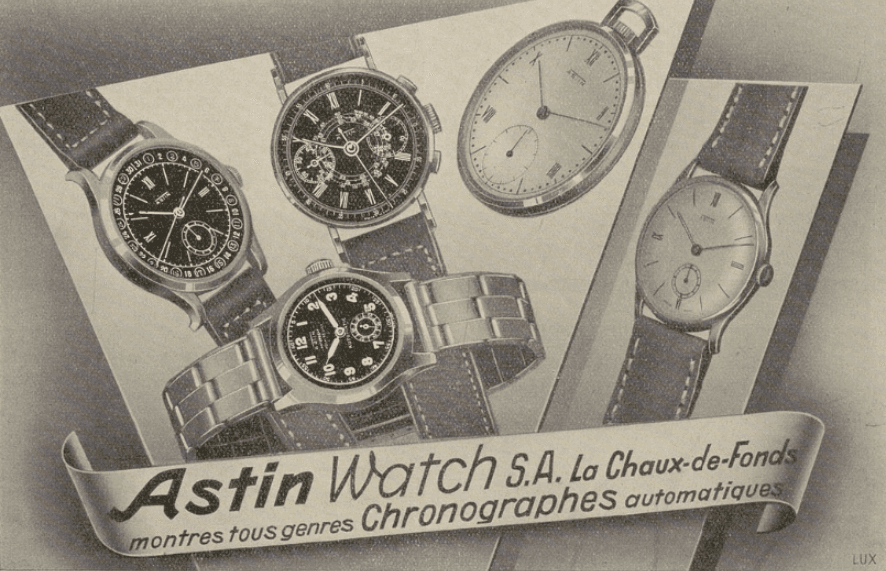
Surviving examples from the Bozonnat era point to a focus on chronograph production: Landeron 48 and Valjoux 22 calibres have been documented in Astin-signed watches from the late 1930s and 1940s.11 In June 1941, shareholders converted the company's nominative shares to bearer shares, a corporate structure change that may reflect growing commercial activity or a preparation for eventual sale.12
The same 1942 JSH directory provides a snapshot of the company's management before the Schwarz acquisition: Theodore-Henri Capra is listed as directeur administrateur and Maxime Crevoisier (who had joined the board in 1937) as comptable (accountant).10b Bozonnat's name does not appear; by 1942 the day-to-day management had passed to Capra.
The Schwarz takeover
On 12 May 1944, the Schwarz family made it official. The FOSC entry published 13 June 1944 records that Henri-Louis Schwarz of Trubschachen replaced Capra as administrator. Gaston-Paul Schwarz, also of Trubschachen, was appointed director in place of Andre Bozonnat.13 The ASTIN trademark was renewed in December 1944, months after the takeover, confirming the new owners' intent to continue the brand.13b
Astin was now the fourth brand in the Schwarz portfolio, alongside Alpha, Sultana, and Le Phare, all operating from the Palais Invar. But the internal dynamics shifted quickly. By 1946, Gaston Schwarz's directorship had been terminated and Marguerite Brandt was appointed director in his place.13c Gaston's tenure lasted barely two years. The reasons are not documented in the commercial register.
The surviving watches from the post-acquisition period are predominantly time-only dress watches, suggesting a shift away from the chronograph specialization of the Bozonnat years, though at least one triple-date chronograph with a Valjoux 72C movement has been documented from the early 1950s.14
A common confusion in online discussions of the Schwarz-Etienne brand family involves the name "Venus." Schwarz-Etienne used "Montres Venus" as a brand name on finished watches. This is entirely unrelated to Venus SA (Fabrique d'Ebauches Venus) of Moutier, the famous chronograph movement manufacturer founded in 1923 and later absorbed by Valjoux. The two entities share nothing beyond the name.15
In February 1956, an extraordinary general assembly appointed Hedwige Schwarz as president of the board of administration. Andre Schwarz, previously holding power of attorney, was promoted to administrator.15b Later that year, the company established a formal employee pension fund ("Fonds de prevoyance en faveur du personnel de Astin Watch Co S.A."), administered by a three-person committee with Henri-Louis Schwarz as president. The fund was constituted by authenticated act on 2 July 1956, covering staff welfare in cases of hardship, unemployment, retirement, illness, accidents, and death.16 The existence of a formal welfare foundation suggests a company of some substance, not merely a dormant brand name.
The trademark portfolio tells the same story. Federation of the Swiss Watch Industry records show the ASTIN mark was renewed in March 1958 and the NITSA mark in April 1958, and the Encanto mark was renewed as late as October 1959.16b Through the late 1950s, Astin was still actively maintaining its brand registrations.
The final years
In 1964, a Schwarz-Etienne corporate advertisement published in both Europa Star Europe and Europa Star Asia still claimed Astin as part of the family portfolio: "De cette famille sortirent les maisons Sultana, Le Phare et Astin" (from this family sprang the firms of Sultana, Le Phare and Astin).16c The French text of the same advertisement names five Schwarz children who entered the business: Ernest, Helvetia, Gaston, Herbert, and Henry-Louis. This is a larger family than secondary accounts have documented, and raises the question of whether "Hedwige Schwarz," the board president, was in fact Helvetia Schwarz or the wife of one of the brothers.
The end came not suddenly but through a sequence of departures. On 12 March 1965, Henri-Louis Schwarz resigned as administrator.16d Later that year, the employee pension fund statutes were modified by decree of the Conseil d'Etat of the Republic and Canton of Neuchatel, with the modified act noting that Henri-Louis Schwarz "ne fait plus partie" of the committee.16e The company still had employees. The fund still required at least three committee members appointed by the board, at least one of whom had to be an administrator.
Then, in a notice registered 27 June 1966 and published the following week, the FOSC recorded the event that effectively sealed the company's fate: "Hedwige Schwarz, presidente, est decedee. Elle est radiee. Andre Schwarz, administrateur, est dorenavant administrateur unique."16f Hedwige Schwarz, the board president, had died. Andre Schwarz was now alone.
Three years later, on 6 October 1969, an extraordinary general assembly renamed the company "Astin S.A." and changed its purpose to achat, vente et exploitation d'immeubles: the purchase, sale, and exploitation of real estate. The registered address remained Avenue Leopold-Robert 94, now listed as "c/o Schwarz-Etienne S.A."17 In July 1970, the Astin employee pension fund was dissolved and its assets and liabilities merged into the Schwarz-Etienne staff fund.17b The employees were absorbed, not abandoned. The Astin name, as a watchmaking concern, was finished.
Surviving examples
Astin watches surface occasionally at regional auction houses and through specialist dealers, but they are not common. The brand does not appear in the catalogues of the major Geneva houses. Prices range widely: 18K gold chronographs from the Bozonnat era have sold in the low four figures,18 while chrome-cased and gold-plated dress watches from the Schwarz period appear for well under $100. A triple-date chronograph with a Valjoux 72C movement, one of the more desirable Astin configurations, has been listed by a Swiss specialist dealer at CHF 7,500.19
The specimen in the Remontorium collection is a different kind of piece: an 18K rose gold square-cased dress watch with a two-tone salmon dial, housing a Cal. 006 manual-wind movement with 15 jewels. Cal. 006 does not appear in any published movement database and is likely an internal Astin or Schwarz-Etienne designation applied to a standard purchased ebauche. The watch was sold at Bonhams Cornette de Saint Cyr, Paris, in April 2026 (Lot 30, "Property of a Noble Collector"), catalogued as circa 1950. Whether it dates from the late Bozonnat years or the early Schwarz period cannot be determined without further examination of the case hallmarks and movement.
The building is still there
Schwarz-Etienne, the parent company that absorbed Astin's employees and pension fund, is still making watches at Avenue Leopold-Robert in La Chaux-de-Fonds. The firm survived the quartz crisis, was acquired in 2007 by entrepreneur Raffaello Radicchi, and reinvented itself as an independent manufacture developing proprietary in-house calibres. Its official history names Chanel, Dunhill, and Mauboussin among its historical clients. Today it is perhaps best known as the manufacturer behind MING, the Malaysian microbrand whose watches use Schwarz-Etienne ASE-family movements and are produced in the same facility.19b
The Astin brand died in 1969, but the infrastructure and expertise that sustained it did not. The building, the workforce, and the institutional knowledge passed to Schwarz-Etienne and continue to produce watches to this day.
A note on the capital
The company was founded with CHF 3,000 in 1926 and remained at that level through the bankruptcy, revival, and Bozonnat's arrival in 1936. In August 1937, Bozonnat recapitalised the firm at CHF 50,000 (100 shares of 500 francs), though only CHF 20,000 was actually paid in.8 That the company built a portfolio of eight brand names, filed multiple trademark registrations, and operated for over three decades on a capital base of CHF 50,000 — with less than half paid up — is a measure of how far commercial ambition could stretch in mid-century Swiss watchmaking.
Notes
[1] Feuille Officielle Suisse du Commerce (FOSC), N. 18, 23 January 1926, p. 128. Available at E-periodica. ↑
[2] FOSC, N. 148, 28 June 1927, p. 1190. Available at E-periodica. ↑
[3] FOSC, N. 266, 14 November 1931, p. 2426. Available at E-periodica. ↑
[4] FOSC, N. 33, 10 February 1932, p. 346. Available at E-periodica. ↑
[5] FOSC, N. 239, 12 October 1936, p. 2399. Available at E-periodica. ↑
[6] Grail Watch, "Palais Invar, the First Watch Boutique in La Chaux-de-Fonds" (2023). See also Schwarz-Etienne, official history. ↑
[7] Grail Watch Wiki, "Sultana"; Grail Watch Wiki, "Gaston Schwarz". ↑
[8] FOSC, N. 202, 31 August 1937, p. 2009. Available at E-periodica. ↑
[9] FOSC, 1938, p. 1111. Trademarks No. 92890 (ASTIN) and No. 92891 (NITSA), both filed 7 April 1938, for "mouvements de montres complets et montres terminees." Available at E-periodica. ↑
[10] FOSC, 1939. Encanto and Austin trademarks. The Encanto mark (No. 96014) is independently confirmed by its 1959 FH renewal (see fn16b). The Austin mark is referenced in secondary accounts. ↑
[10b] Journal Suisse d'Horlogerie, 1942, p. 183. Company directory entry: "Compagnie des Montres ASTIN, La Chaux-de-Fonds. Mr. Th. H. Capra directeur administrateur et comptable M. Maxime Crevoisier." Lists brand names: Tolek, Monteco, OCTO. Accessed via The Watch Library Foundation, document MIH-JSH_1942. ↑
[10c] Archives de l'horlogerie (Federation of the Swiss Watch Industry), 1958 (printed p. 50). MOBILIA trademark (renewal of No. 93564), 1 September 1958. "Horlogerie (montres de poche et montres-bracelets)." Compagnie des Montres Astin S.A., La Chaux-de-Fonds. Accessed via The Watch Library Foundation, document FH-AH_1958. ↑
[11] Landeron 48 confirmed by eBay parts listing (item 262813027426, Astin-signed dial on Landeron 48 movement). Valjoux 22 confirmed by WatchUSeek for-sale listing (Astin gilt-dial chronograph, Spillman case, Valjoux 22, 38mm, 1940s). ↑
[12] FOSC, 3 July 1941. Share conversion from nominative to bearer shares. Available at E-periodica. ↑
[13] FOSC, N. 136, 13 June 1944, p. 1332. Available at E-periodica. ↑
[13b] Archives de l'horlogerie (Federation of the Swiss Watch Industry), 1944 (printed p. 189). ASTIN trademark No. 120974 (renewal referencing original Swiss mark No. 92890), filed 9 December 1944. "Compagnie des montres Astin S.A., Fabrication, La Chaux-de-Fonds." Accessed via The Watch Library Foundation, document FH-AH_1944. ↑
[13c] Journal Suisse d'Horlogerie, 1946, p. 710. Registre du Commerce: "Compagnie des Montres Astin S.A., La Chaux-de-Fonds: Marguerite Brandt est nommee directrice. La signature du directeur Gaston Schwarz est radiee." Accessed via The Watch Library Foundation, document MIH-JSH_1946. ↑
[14] Watch-Spare, Astin triple-date chronograph, Valjoux 72C, stainless steel 36mm, serial #3157, dated c. 1950-1955, CHF 7,500. ↑
[15] Watch Wiki, "Venus". Venus SA (Fabrique d'Ebauches Venus) was founded in Moutier in 1923, joined Ebauches SA in 1928, and was absorbed by Valjoux in 1966. Schwarz-Etienne's "Montres Venus" was a separate commercial brand name used on finished watches. ↑
[15b] Journal Suisse d'Horlogerie, 1956, p. 263. "Compagnie des Montres Astin S.A., La Chaux-de-Fonds: Dans son assemblee generale extraordinaire du 14 fevrier 1956, Hedwige Schwarz a ete nommee presidente du Conseil d'administration. Andre [printed as 'Arnold' in the JSH; the FOSC pension fund entry from the same year (see fn16) gives the name as Andre] Schwarz, precedemment fonde de pouvoirs, a ete nomme administrateur avec signature collective a deux." Accessed via The Watch Library Foundation, document MIH-JSH_1956. ↑
[16] FOSC, 21 July 1956. "Fonds de prevoyance en faveur du personnel de Astin Watch Co S.A.," constituted by authenticated act of 2 July 1956. Henri-Louis Schwarz of Trubschachen as president. Available at E-periodica. ↑
[16b] Archives de l'horlogerie (Federation of the Swiss Watch Industry): ASTIN mark renewed 27 March 1958; NITSA mark renewed 3 April 1958 (FH-AH_1958, printed p. 22). ENCANTO mark No. 173827 (renewal of No. 96014) renewed 15 October 1959 (FH-AH_1959, printed p. 41). Accessed via The Watch Library Foundation. ↑
[16c] Europa Star Europe, Issue 27, 1964, p. 7; Europa Star Asia, Issue 82, 1964, p. 9. Schwarz-Etienne corporate advertisement under "Montres Venus" brand. French text: "Mr. Schwarz eut cinq enfants: Ernest, Helvetia, Gaston, Herbert et Henry-Louis qui entrerent dans l'affaire. De cette famille sortirent les maisons Sultana, Le Phare et Astin." English text: "From this family sprang the firms of Sultana, Le Phare and Astin." Accessed via The Watch Library Foundation. ↑
[16d] FOSC, N. 65, 19 March 1965, p. 871. "Compagnie des Montres Astin S.A. (Astin Watch Co S.A.), a La Chaux-de-Fonds. L'administrateur Henri-Louis Schwarz a demissionne; ses pouvoirs sont eteints." Available at E-periodica. ↑
[16e] FOSC, N. 260, 6 November 1965, p. 3494. Modification of the "Fonds de prevoyance en faveur du personnel de Astin Watch Co S.A." by decree of the Conseil d'Etat de la Republique et Canton de Neuchatel, 24 September 1965. Available at E-periodica. ↑
[16f] FOSC, N. 155, 6 July 1966, p. 2177. "Hedwige Schwarz, presidente, est decedee. Elle est radiee. Andre Schwarz, administrateur, est dorenavant administrateur unique. Il continue de signer individuellement." Available at E-periodica. ↑
[17] FOSC, 16 October 1969, p. 2466. Conversion to Astin SA. Available at E-periodica. ↑
[17b] FOSC, 1 July 1970, p. 1755. Astin employee pension fund dissolved; assets and liabilities merged into "Fonds de prevoyance en faveur du personnel de la maison Schwarz-Etienne S.A." Available at E-periodica. ↑
[18] LiveAuctioneers, Manor Auctions, Vero Beach FL, March 2013 ($700); LiveAuctioneers, Converse Auctions, Paoli PA, August 2017 ($1,600). ↑
[19b] Schwarz-Etienne, official history: names Chanel, Dunhill, Mauboussin, and Caran d'Ache as historical clients. MING's use of Schwarz-Etienne movements is documented at ming.watch. ↑
[19] Watch-Spare, Astin triple-date chronograph, Valjoux 72C, stainless steel 36mm, serial #3157, CHF 7,500. ↑
Bibliography
Feuille Officielle Suisse du Commerce, volumes 1926-1970. Available at E-periodica.
Europa Star Europe and Europa Star Asia, 1964. Accessed via The Watch Library Foundation (watchlibrary.org).
Journal Suisse d'Horlogerie, volumes 1942, 1946, 1956. Accessed via The Watch Library Foundation (watchlibrary.org).
Archives de l'horlogerie (Federation of the Swiss Watch Industry), volumes 1944, 1958, 1959. Accessed via The Watch Library Foundation.
Grail Watch, "Palais Invar, the First Watch Boutique in La Chaux-de-Fonds," grail-watch.com (2023).
Schwarz-Etienne, official history, schwarz-etienne.ch.